Showing posts with label computer vision. Show all posts

NIPS 2016


I have just returned from NIPS (technically, I am still continuing travelling in Canary Islands). Surprisingly, this is my first NIPS. I have enjoyed presentations of great work, as well as communicating with machine-learning folks and friends. Here is an edited high-level write-up I prepared for my co-workers at BlippAR, hence the focus on computer vision and deep learning. The scope of the conference is of course much broader.

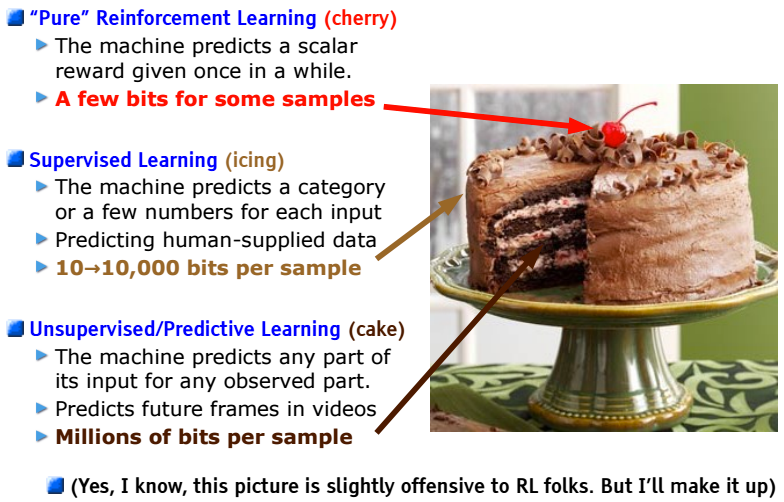
In the beginning of the conference, Yann LeCun gave a keynote, which may be considered a program speech for the whole conference. Besides starting the layered cake meme, he mentioned two ideas that he considers brightest in the last decade: adversarial training and external memory. My perception is that the most frequent buzzwords at the conference are:
  • generative adversarial networks (GAN),
  • recurrent neural networks (RNN),
  • reinforcement learning (RL),
  • robotics (done with or without RL).
Great engineers are good at defining useful abstractions. This LeCun’s layered cake metaphor was heavily re-used throughout the conference.
Andrew Ng gave a keynote on the workflow of applied DL research. Most ideas are trivial, although are often neglected. Here are a few of them. The most important metrics to track are: human error, training set error, and validation error. The gap between human and training set error is the bias. It can be solved by a bigger model or longer training. The validation/training gap is due to the variance. Once the bias problem is addressed, you can add more data or increase regularisation to reduce variance.

In practice, however, we have a different distribution of test data than of the training data. In that case, you might want to have two validation sets: one coming from training distribution, and another from test distribution. If you don’t have the latter, you will be solving a wrong problem. Domain adaptation methods may be also helpful, but are not quite practical at the moment.
He also heavily advocates for using the centralised data storage infrastructure that is easily available to all team members. It speeds up the progress a lot.
Currently, supervised learning dominates the landscape, while unsupervised and reinforcement learning are around for some time, but still cannot take off. Ng predicts that the second-biggest areas (after SL) will be not one of those, but transfer learning and multi-task learning. Those are important practical areas almost ignored by academic researchers.

There were seemingly few papers on architectural design (for supervised learning). Daniel Sedra gave a great talk on Neural networks of stochastic depth. The idea is to drop entire layers during training in ResNet-like architectures. That allows to grow them up to 1000+ layers, which gives significant improvement in accuracy on CIFAR (and not quite significant on ImageNet). Unfortunately, at test-time layers are there, so the inference time may be a problem. Another improvement is to add identity connection between each pair of layers, which also helps a bit.

Michael Figurnov, my academic sibling, presented a work on speeding up inference using so-called perforated convolutions. The idea is to skip some multiplications that do not impact the result of the operation a lot. In the follow-up work, he and co-authors suggest to skip the whole parts of the computation graph once they are estimated to be unimportant. This can potentially lead to significant speed-up, but for most practitioners it is the question of support in libraries such as CUDNN. Hopefully, we’ll be able to use it soon.
The method suggest not to waste computation time on background, but evaluate more ResNet layers where it can pay out more.
There was a demo I missed that demonstrated real-time object detection on a mobile device (if you have a link, please share with me!). It is based on YOLO, and the idea is to pre-compute and memoize some parts of the computational graph, then at inference time find the best approximation. There is some loss in accuracy, but real-time inference on the board looks impressive! 

The most interesting improvement for deep learning optimisation seems to be Weight normalisation. The paper builds on the idea of batch normalisation. It tries to explain the positive effect of it (i.e. staying on the unit sphere) and uses this intuition to propose an alternative way to stabilise the training process.

As I said above, GANs are a big (and controversial) topic here. It seems to be the most popular generative model for images, although variational autoencoders are still around. The training process is quite unstable, but the community is increasingly finding the ways to stabilise it. Most of them are hacks born in trial-and-error process. Soumith Chintala presented a list of 15 tricks in his talk How to train GAN? He promised to publish the slides later, but here is the writeup. If you will have to train GANs, make sure you read that first. There is no way you can guess this combination yourself (and papers typically do not mention all those hacks).
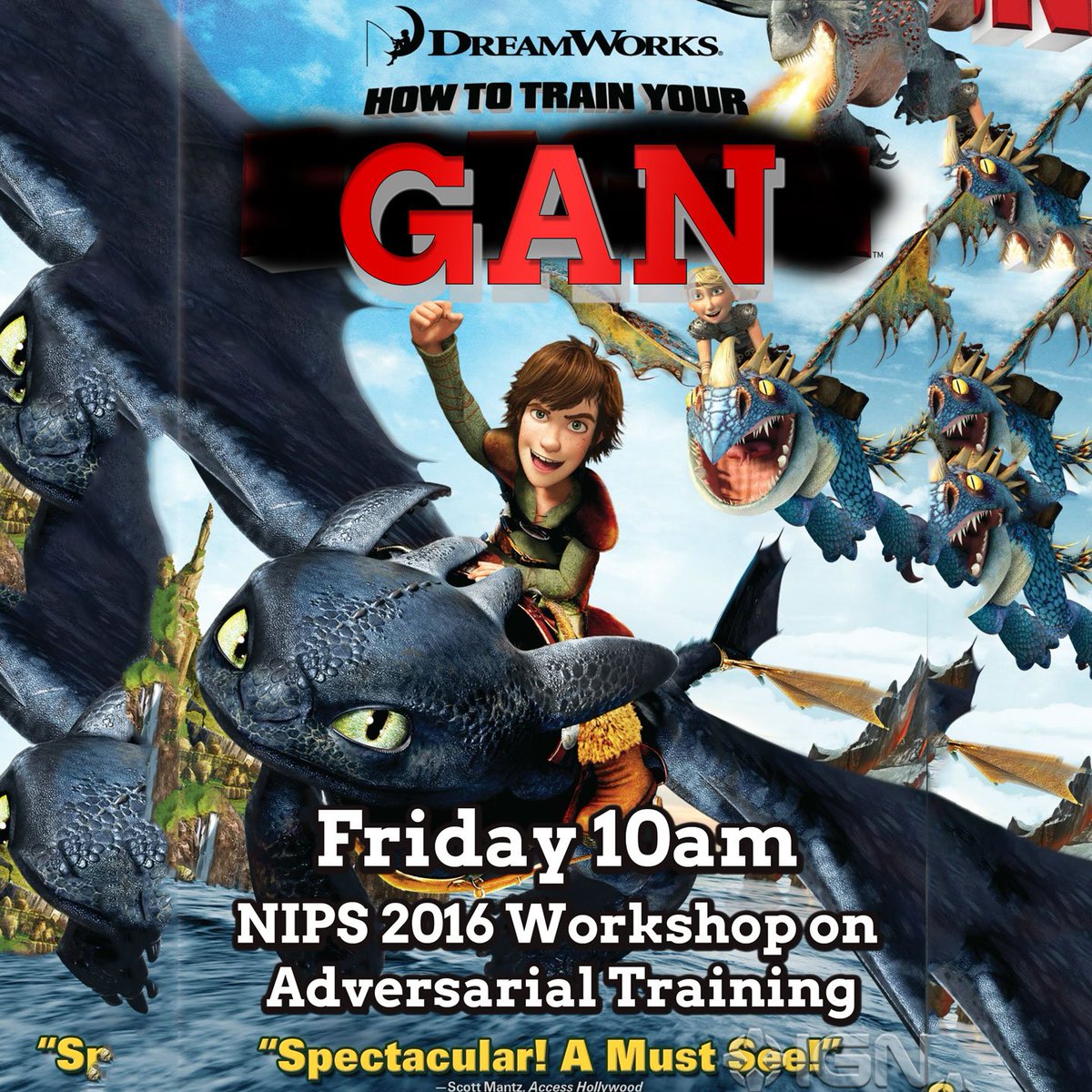
Poster by Soumith. TL;DR: use magic.
In the visual search field, there is a Universal correspondence network paper. Instead of matching features, it suggests to run one pass through the network to find dense correspondences. They claim that in comparison to extracting deep features for patches, the number of distance computations gets down from quadratic to linear (although, spatial index can also mitigate the issue). It appears to learn some notion of geometry/topology, i.e. one can train it to do rigid matching, as well as to look more at semantic similarity. The results they showed were on very similar images, so did not impress me much. Although it may had been done only to ease the visualisation.
Deep learning continues to disrupt traditional computer-vision pipelines.
For reinforcement learning, there is no single paper that I can pick as brightest, but the most impact seems to be done by publishing OpenAI Universe and DeepMind Lab, both are training environments for reinforcement learning algorithms stemming from computer-generated imagery (i.e. video games). It seems to be a valid step towards building intelligent agents operating in the real world, although there is a scepticism that it will be difficult to make the final step: the methods are data-hungry, and it is difficult to get a lot of data from anything rather than simulated environment, let alone having a frequent reward signal. This is one of the reasons researchers study the possibility of imitation learning, where a robot learns the cost function from demonstrations rather than taking it for granted. With this approach, we may be able to teach robots to perform tasks like pouring water into a glass by having a person or another robot showing it how to do it.
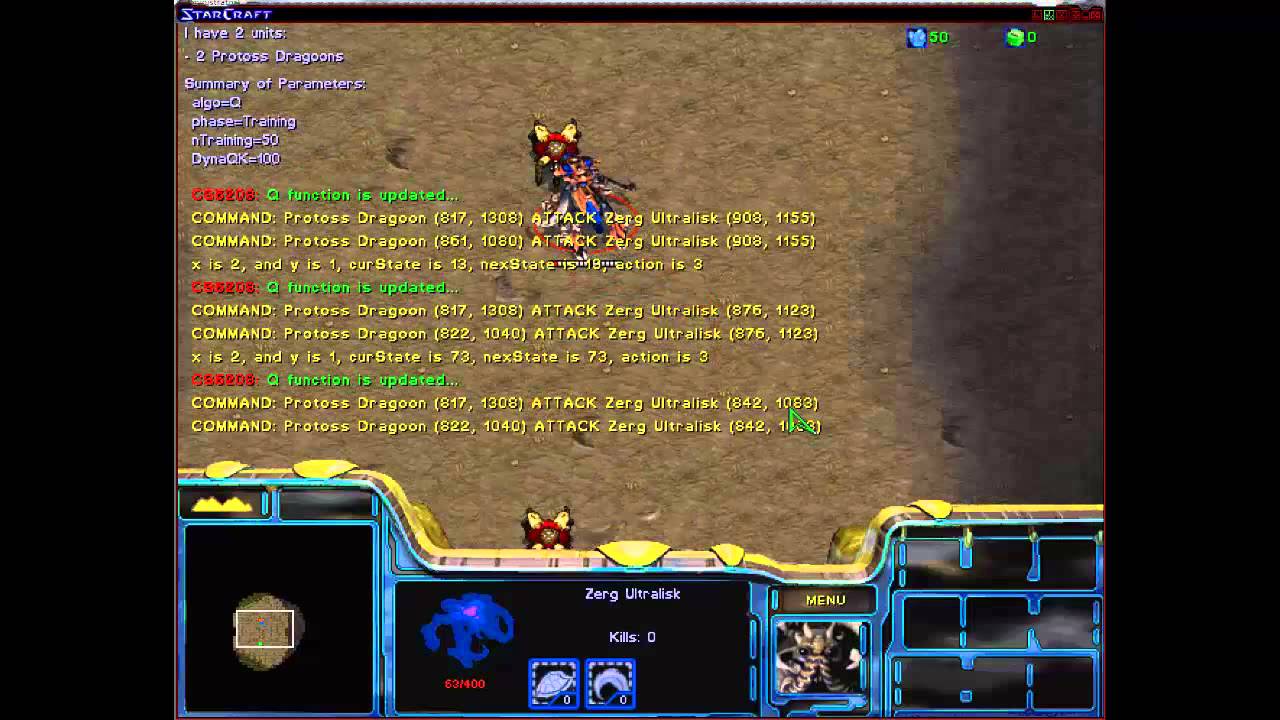
DeepMind collaborated with Blizzard to provide StarCraft API to facilitate training of RL agents. Now you have an excuse to play games at work.
Bayesian methods seem to be quite popular, and apparently can be successfully combined with neural networks (variational autoencoders and their variants are used a lot). Workshops on approximate variational inference and Bayesian deep learning have seen a large number of papers. Tutorial on variational inference (slides-pdf-1, slides-pds-2) reflected a significant progress in the recent years: things like reparametrisation trick and stochastic optimisation made possible to perform estimation of quite sophisticated posterior distributions. 
Slide by David Blei. Bayesian models have been long used successfully to estimate uncertainty, in particular to glue models to get complex pipelines while avoiding information loss. It is great we can use it with modern models as well.
Surely, an important part of the conference is socialisation. So thanks to everybody I had a chance to meet at the conference and had a productive (or just fun) conversation with. See you at the future conferences!

Read Users' Comments (9)

Kinect Apps Challenge

Graphics & Media Lab and Microsoft Research Cambridge have announced a contest for applications that use Kinect sensor. The authors of the five brightest apps will be funded to attend the 2012 Microsoft Research PhD summer school. I blogged about the last year's event in my previous post. Details of the contest are here.

I guess there's no need to explain what Kinect is. It is extremely successful combined colour and depth sensor by Microsoft. It is being distributed for killer price (≈$150) as an add-on for Xbox, although it is hard to imagine the range of possible applications. Controlling a computer only by gestures is considered as a primer of natural user interface. To name some applications beyond gaming, this kind of NUI is useful to help surgeons to keep their hands clean:

Kinect helps blind people to navigate through buildings:

For more ideas look at the winners of OpenNI challenge.

OpenNI is an open-source alternative to Kinect SDK. Its strong point is it is integrated with PCL, but beware that you cannot use it for the contest. Only Kinect for Windows SDK is allowed.

Kinect is probably the most successful commercial outcome from the Microsoft Research lab. MSR is unique because they do a lot of theoretical research there, and it is unclear if it is profitable for Microsoft to fund it. But the projects like Kinect reveal the doubts. I will post about MSR organization in comparison to other industrial labs in one of the later posts.

Read Users' Comments (2)

All the summer schools

This summer I attended two conferences (3DIMPVT, EMMCVPR) and two summer schools. I know my latency is somewhat annoying, but it's better to review them now then never. :) This post is about the summer schools, and the following is going to be about the conferences.


PhD Summer School in Cambridge

Both schools were organized by Microsoft Research. The first one, PhD Summer School was in Cambridge, UK. The lectures covered some general issues for computer science PhD students (like using cloud computing for research and career perspectives) as well as some recent technical results by Microsoft Research. From the computer vision side, there were several talks:
  • Antonio Criminisi described their InnerEye system for retrieval of similar body part scans, which is useful for diagnosis based on similar cases' medical history. He also featured the basics of Random Forests as an advertisement to his ICCV 2011 tutorial. The new thing was using peculiar weak classifiers (like 2nd order separation surfaces). Antonio argued they perform much better then trees in some cases.
  • Andrew Fitzgibbon gave a brilliant lecture about pose estimation for Kinect (MSR Cambridge is really proud of that algorithm [Shotton, 2011], this is the topic for another post).
  • Olga Barinova talked about the modern methods of image analysis and her work for the past 2 years (graphical models for non-maxima suppression for object detection and urban scene parsing).
The other great talks were about .NET Gadgeteer, the system for modelling and even deployment of electronic gadgets (yes, hardware!), and F#, Microsoft's alternative to Scala, the language that combines object-oriented paradigm with functional. Sir Tony Hoare also gave a lecture, so I had a chance to ask him how he ended up in Moscow State University in the 60s. It turns out he studied statistics, and Andrey Kolmogorov was one of the leaders of the field that time, so that internship was a great opportunity for him. He said he had liked the time in Moscow. :) There were also magnificent lectures by Simon Peyton-Jones about giving talks and writing papers. Those advices are the must for everyone who does research, you can find the slides here. Slides for some of the lectures are available from the school page.

The school talks did not take all the time. Every night was occupied by some social event (go-karting, punting etc.) as well as unofficial after-parties in Cambridge pubs. Definitely it is the most fun school/conference I've attended so far. Karting was especially great, with the quality track, pit-stops, stats and prizes, so special thanks to Microsoft for including it to the program!


Microsoft Computer Vision School in Moscow

This year, Microsoft Research summer school in Russia was devoted to computer vision and organized in cooperation with our lab. The school started before its official opening with a homework assignment we authored (I was one of four student volunteers). The task was to develop an image classification method capable to distinguish two indoor and two outdoor classes. The results were rated according to the performance on the hidden test set. Artem Konev won the challenge with 95.5% accuracy and was awarded a prize consisted of an xBox and Kinect. Two years ago we used those data for the projects on Introduction to Computer Vision course, where nobody reached even 90%. It reflects not just the lore of participants, but also the progress of computer vision: all the top methods used PHOW descriptors and linear SVM with approximate decomposed χ2 kernel [Vedaldi and Zisserman, 2010], which were unavailable that time!

In fact, Andrew Zisserman was one of the speakers. Andrew is the most cited computer vision researcher and the only person whose Zisserman number is zero. :) His course was on Visual Search and Recognition, including instance-level and category-level recognition. The ideas that were relatively new:
  • when computing visual words, sometimes it is fruitful to use soft assignments to clusters, or more advanced methods like Locality-constrained linear coding [Wang et al., 2010];
  • for instance-level recognition it is possible to use query expansion to overcome occlusions [Chum et al., 2007]: the idea is to use the best matched images from the base as new queries;
  • object detection is traditionally done with sliding window, the problems here are: various aspect ratio, partial occlusions, multiple responses and background clutter for substantially non-convex objects;
  • for object detection use bootstrapped sequential classification: on the next stage take the false negative detections from the previous stage as negative examples and retrain the classifier;
  • multiple kernel learning [Gehler and Nowozin, 2009] is a hot tool that is used to find the ideal linear combination of SVM kernels: combining different features is fruitful, but learning the combination is not much better than just averaging (Lampert: “Never use MKL without comparison to simple baselines!”);
  • movies are common datasets, since there are a lot of repeated objects/people/environments, and the privacy issues are easy to overcome. The movies like Groundhog Day and Run Lola Run are especially good since they contain repeated episodes. You can try to find the clocks on Video Google Demo.
Zisserman talked about PASCAL challenge a lot. During a break he mentioned that he annotated some images himself since “it is fun”. One problem with the challenge is we don't know if the progress over years really reflects the increased quality of methods, or is just because of growth of the training set (though, it is easy to check).

Andrew Fitzgibbon gave two more great lectures, one about Kinect (with slightly different motivation than in Cambridge) and another about continuous optimization. He talked a lot about reconciling theory and practice:
  • the life-cycle of a research project is: 1) chase the high-hanging fruit (theoretically-sound model), 2) try to make stuff really work, 3) look for the things that confuse/annoy you and fix them;
  • for Kinect pose estimation, the good top-down method based on tracking did not work, so they ended up classifying body parts discriminatively, temporal smoothing is used on the late stage;
  • “don't be obsessed with theoretical guarantees: they are either weak or trivial”;
  • on the simplest optimization method: “How many people have invented [coordinate] alternation at some point of their life?”. Indeed, the method is guaranteed to converge, but the problems arise when the valleys are not axis-aligned;
  • gradient descent is not a panacea: in some cases it does small steps too, conjugate gradient method is better (it uses 1st order derivatives only);
  • when possible, use second derivatives to determine step size, but estimating them is hard in general;
  • one almost never needs to take the matrix inverse; in MATLAB, to solve the system Hd = −g, use backslash: d = −H\g;
  • the Friday evening method is to try MATLAB fminsearch (implementing the derivative-free Nelder-Mead method).
Dr. Fitzgibbon asked the audience what the first rule of machine learning is. I hardly helped over replying “Never talk about machine learning”, but he expected the different answer: “Always try the nearest neighbour first!”

Christoph Lampert gave lectures on kernel methods, and structured learning, and kernel methods for structured learning. Some notes on the kernel methods talk:
  • (obvious) don't rely on the error on a train set, and (less obvious) don't even report about it in your papers;
  • for SVM kernels, in order to be legitimate, a kernel should be an inner product; it is often hard to prove it directly, but there are workarounds: a kernel can be drawn from a conditionally positive-definite matrix; sum, product and exponent of a kernel(s) is a kernel too etc. (thus, important for multiple-kernel learning, linear combination of kernels is a kernel);
  • since training (and running) non-linear SVMs is computationally hard, explicit feature maps are popular now: try to decompose the kernel back to conventional dot product of modified features; typically the features should be transformed to infinite sums, so take first few terms [Vedaldi and Zisserman, 2010];
  • if the kernel can be expressed as a sum over vector components (e.g. χ2 kernel $\sum_d x_d x'_d / (x_d + x'_d)$), it is easy to decompose; radial basis function (RBF) kernel ($\exp (\|x-x'\|^2 / 2\sigma^2)$) is the exponent of a sum, so it is hardly decomposable (more strict conditions are in the paper);
  • when using RBF kernel, you have another parameter σ to tune; the rule of thumb is to take σ² equal to the median distance between training vectors (thus, cross-validation becomes one-dimensional).
Christoph also told a motivating story why one should always use cross-validation (so just forget the previous point :). Sebastian Nowozin was working on his [ICCV 2007] paper on action classification. He used the method by Dollár et al. [2005] as a baseline. The paper reported 80.6% accuracy on the KTH dataset. He outperformed the method by a couple of per cents and then decided to reproduce Dollár's results. Imagine his wonder when simple cross-validation (with same features and kernels) yielded 85.2%! So, Sebastian had to improve his method to beat the baseline.

I feel I should stop writing about the talks now since the post grows enormously long. Another Lampert's lecture and Carsten Rother's course on CRFs were close to my topic, so they deserve separate posts (I already reviewed basics of structured learning and max-product optimization in this blog). Andreas Müller blogged about the recent Ivan Laptev's action recognition talk on CVML, which was pretty similar to ours. The slides are available for all MSCVS talks, and videos will be shared in September.

There were also several practical sessions, but I personally consider them not that useful, because one hardly ever can feel the essence of a method in 1.5 hours changing the code according to some verbose instruction. It is more of an art to design such tutorials, and no one can really master it. :) Even if the task is well-designed, one may not succeed performing it due to technical reasons: during Carsten Rother's tutorial, Tanya and me spent half an hour to spot the bug caused by confusing input and index variable names (MATLAB is still dynamically typed). Ondrej Chum once mentioned how his tutorial was doomed since half of the students did not know how to work with sparse matrices. So, practical sessions are hard.

There was also a poster session, but I cannot remember a lot of bright works, unfortunately. Nataliya Shapovalova who won the best poster award, presented quite interesting work on action recognition, which I liked as well (and it is not the last name bias! :) My congratulations to Natasha!

The planned social events were not so exhaustive as in Cambridge, but self-organization worked out. The most prominent example was our overnight walk around Moscow, in which a substantial part of school participants took part. It included catching last subway train, drinking whiskey and gin, a game of guessing hallucinating names of each other, and moving a car from the tram rail to let the tram go in the morning. :) I also met some of OpenCV developers from Nizhny Novgorod there.


MSCVS is a one-time event, unfortunately. There are at least three annual computer vision summer schools in Europe: ICVSS (the most mature one, I attended it last year), CVML (held in France by INRIA) and VSSS (includes sport sessions besides the lectures, held in Zürich). If you are a PhD student in vision (especially in the beginning of your program), it is worth attending one of them each year to keep up with current trends in the vision community, especially if you don't go to the major conferences. The sets of topics (and even speakers!) have usually large intersection, so pick one of them. ICVSS has arguably the most competitive participant selection, but the application deadline and acceptance notification are in March, so one can apply to the other schools if rejected.

Read Users' Comments (7)

Google search by image

Last week Google introduced Search by Image feature. There were a handful of web-sites that suggested content-based image retrieval in the Internet, but the quality was low, as I blogged earlier. I repeated the queries TinEye failed at, and Google image search found them both! It found few instances of Marion Lenbach (one of them from this blog, which means the coverage is large!), and I finally remembered the movie from the HOG paper: The Talanted Mr. Ripley.

So, from the quick glance Google finally accomplished what the others could not do for ages. Why did they succeed? There are two possible reasons: large facilities that allow building and storing large index efficiently, and a unique technology. The former is surely the case: it seems the engine indexed a large portion of the photos in the web. I cannot say anything about the technology: there is nothing about that among the Google's CVPR papers, so one need to do black-box testing to see which transformations and modifications are allowed.

Google seems to expand to the areas of multimedia web, even where the niche is already occupied. Recently they announced their alternative to grooveshark, the recommendation system for Music beta (the service is unfortunately available on invitation basis in the US only). The system is not based on collaborative filtering (only), they (also) analyse the content. I planned to investigate this area too, but given that it is becoming mature and thus not so alluring. I am eager to see if the service will succeed. After all, Buzz did not replace Twitter, and Orkut did not replace Facebook.

Read Users' Comments (1)comments

[CFP] GraphiCon-2011 and MSCVSS

Our lab traditionally organizes GraphiCon, the major (and may be the only) conference in Russia specialized in computer graphics and computer vision. The conference is not very selective, still it has a decent community of professionals behind it. So, if you want to get a quality feedback on your preliminary work, or always wanted to visit Russia, consider submitting a paper by May, 16.

Special offer for young readers of my blog: If it is the place where you learned about the conference and decided to submit a paper, I'll buy you a beer during the conference. :) Consider it another social micro-event.

Another piece of news is primarily for undergrads and PhD students from Russia. Our lab and Microsoft Research organize another event this summer: Computer vision summer school. There are such lecturers as Cristoph Lampert and Andrew Zisserman, among others. Participation is free of charge, and accommodation is provided. Deadline is on April, 30. You should not miss it!

Read Users' Comments (2)

Art + Multimedia

In December we visited a lecture about interaction between arts and sciences, namely between (primarily) visual arts and (again, primarily) multimedia studies (Russian page). The lecture was given by Asya Ablogina, who turned out to be a nice girl. Although she lacked any technical background, she was doing well. Surprisingly, there is a lot of artwork that exploits technical support in a witty manner, which I was unaware of, so the lousy stuff exhibited in the Moscow Museum of Modern Art is not everything one can do in this field!

The most interesting part was Asya's exposition of some masterpieces. Most of them were presented during 2009 Science as Suspense exhibit in Moscow (Russian). Nicolas Reeves is a famous Canadian architect, also known for his work on modelling biological systems. He used the output of biologically-inspired computer algorithms (such as genetic algorithms) to draw pictures. In Moscow he presented a project called Marching Floating Cubes: massive but light cubes float in the air. Their movements are controlled by tiny fans, although any little gust of wind can affect the movement. Each cube is equipped with an on-board computer, which helps to avoid collisions. The implemented algorithms are simple but stochastic, hence the behaviour is unpredictable. They are said to move like animal creatures. Here is the video:


A similar project was developed by Paul Granjon. He also tries to gift robots with animal behaviour. In the video below, robots are sexed, i.e. they are able to locate robots of the opposite sex and eventually end up in coitus. Another Paul's robot (the Smartbot, photo) creeps over the restricted space and always grumbles (just like Marvin!). I also enjoy the way Paul speaks:


The real idol in the sci-art community is Stelarc (see also his homepage, although it takes balls to get through the welcome page :). His talent is recognized by both scientists and artists (it is enough to mention he's an Honorary Professor of Arts and Robotics at Carnegie Mellon). He's best known for his experiments on his own body. For example, during a performance he allowed to control his body remotely over the Internet by muscle stimulation. Probably his favourite project is Prosthetic Head, which is in fact a 3D model of his own head. The head is learned from Stelarc's behaviour and speech, so it is able to communicate with people using colloquial information as well as non-verbal cues. It is interesting to try it in practice, but here is just a non-interactive demo video:


Stelarc is probably the only person on Earth who has three ears. In 2007 surgeons implanted an ear into his arm! It is not functioning now (just a piece of skin), but he plans to install an audio receiver into the ear and broadcast everything he hears over the Internet. I definitely recommend to look through his projects, there are decent ones.

Asya also presented her own works. She focus on different photographic techniques such as overexposure. Here are photos from her project Canvas of the Road compiled in a video. There is a play of words in Russian: the single word for canvas and road surface. On these photos car traces look like painter's strokes:


Another Asya's project is a short film series called Habitat. She showed only one episode with the title Habitat: MSU Main Building. The film was about a girl who is a PhD student in Moscow State University and described her place: a standard 8 sq.m. dorm room. The narrative was full of expressive epithets and metaphors about that awful room: the girl felt like in a cage, she also didn't like shared bathroom, etc. It's funny, because I live in a similar PhD student single room, and I'm quite happy with it, since I've been living 5 years in a shared room before. :)

The second lecturer, Vladimir Vishnyakov, presented his project called The Museum of Revived Photography. He used the photos of the XIX century to create image-based animation. The idea is technically simple: first segment people from the background, then use inpainting techniques to restore the background behind them, and animate the movements, but Vladimir referred to a programmer he works with as a real genius. In fact, all the stuff I post here varies from easy to moderately complex (except of Stelarc's projects), so you can do something similar too. The main problem is to come up with the concept. Come on then! ;)

Read Users' Comments (1)comments

Papers, citations, co-authorship, and genealogy

This summer I accidentally found out that there are two papers citing our CMRT 2009 paper. I was excited a bit about that since they were the first actual citations of me, so I even read those papers.

The first of them [Димашова, 2010] was published in Russian by OpenCV developers from Nizhny Novgorod. They implemented cascade-based face detection algorithm that used either Local Binary Patterns (LBP) or Haar features. The algorithm was released within OpenCV 2.0. They cite our paper as an example of using Random Forest on the stages of the cascade. However, they implemented the classical variation with the cascade over AdaBoost.

Another citation [Sikiric et al., 2010] is more relevant since it came from the road mapping community. They address the problem of recovering a road appearance mosaic from the orthogonal views to the surface. They contrast their approach with ours in the way that theirs do not employ human interaction. In fact, we need human input for recognizing road defects and lane marking, rectification is done in the previous stage, which is fully automatic.

The rest of the post is devoted to some interesting metrics and structures concerning citations, co-authorship and supervising students.

Citations

The number of citations is a weak measure of paper quality. We can also go further and estimate the impact of a journal or a particular researcher based on the number of citations. A generally accepted measure is the journal impact factor, which is simply the mean number of citations by paper published in the journal for some period in time. Individual researchers could be evaluated by the impact factor of the journals they published in, though it is considered as a bad practice. Another not-so-bad practise is h-index. By definition, one's h-index equals H if there are at least H citations of his top H papers1. It has also been criticised widely.

So, citation-based scoring has a lot of flaws. But what can we use instead? Another interesting approach is introduced by ReaderMeter. They collect the information about the number of people who have added some paper to their Mendeley collections and compute something like h-index. Unfortunately, they recently excluded some papers from their database, so the statistics became less representative but more accurate.

Co-authorship and Erdős number

Paul Erdős was a Hungarian mathematician who published about 14 hundred research papers with 511 different co-authors. That's why he has a special role in bibliometrics. Erdős number is defined as a collaborative distance from a researcher to Erdős. More strictly, Wikipedia defines:
Paul Erdős is the one person having an Erdős number of zero. For any author other than Erdős, if the lowest Erdős number of all of his coauthors is k, then the author's Erdős number is k + 1.
My Erdős number is at most 7 (via Olga Barinova, Pushmeet Kohli, Philip H.S. Torr, Bernhard Schölkopf, John Shawe Taylor, David Godsil). To be honest, Erdős number system is primarily used for math papers. Even if we use the wider definition, it is not that beautiful, because there are not too many gates, e.g. all the vision community will probably connect to Erdős via the machine learning gate. Thus, the researchers who work on the edge will be closer. To illustrate this fact, David Marr probably had not any finite Erdős number during his lifetime (now he definitely has). So, we can introduce, say, Zisserman number for computer vision.2 According to DBLP, Andrew Zisserman has 165 direct co-authors so far. Now, my Zisserman number is 3, David Marr's is 4 (via Tomaso Poggio, Lior Wolf, Yonatan Wexler).

The movie industry have their own metrics, which is the Bacon number (after Kevin Bacon). The distance is established 1 if two actors have appeared in a single movie. Someone tried to combine those two to the Erdős-Bacon number. For some person, it is just a sum of her Erdős and Bacon numbers. Of course, very few people have a finite Erdős-Bacon number, since one should both appear in a movie and publish a research paper (and it is still not sufficient). Often they are possessed by researchers who consulted the filming crew and accidentally were filmed. =) Erdős himself has this number 3 or 4 (depending on the details of definition), since he starred in N is a Number (1993) and his Bacon number is thus 3 0r 4.

The person with the probably lowest Erdős-Bacon number is Daniel Kleitman, an MIT mathematician, who has appeared in one of my favourite movies Good Will Hunting (1997) along with Minnie Driver, who collaborated with Bacon in Sleepers (1996). Since Kleitman has 6 joint papers with Erdős, his Erdős-Bacon number is 3.

Surprisingly, Marvin Minsky has his Erdős number (4) greater than his Bacon number (2), which he obtained via The Revenge of the Dead Indians (1993) and Yoko Ono. Another strange example is the paedophile's dream Natalie Portman. She has graduated from Harvard, saying she would rather "be smart than a movie star". That's my kind of a girl! A neuroscience paper [Baird et al., 2002] brought Natalie Hershlag (her real name) Erdős number of 5, and then she appeared in New York, I Love You (2009) along with Kevin Bacon, so she reached the same Erdős-Bacon number as Minsky, i.e. 6.

UPD (Mart 13, 2011). There is a totally relevant xkcd strip.

Scientific genealogy

Finally, I tell about what is known as scientific genealogy. Every grown-up researcher has a PhD advisor, usually one, while an advisor can have a lot of students. Let's just use the analogy with parents and children. We get a tree (or a forest) representing the historical structure of science. The mathematics genealogy project aims to recover this structure.

I tried to track my genealogy back. Unfortunately, I failed to find who was Yury M. Bayakovsky's PhD advisor. But if consider Olga Barinova my advisor, I am the 11th generation descendant of Carl Friedrich Gauß. Nice ancestry, huh?

The similar project exists for computer vision. There are 290 people in the base, though there are duplicates (I've found five Vitorio Ferrari's :). It seems strange that some trees have depth as big as 5 (e.g. Kristen Graumann and Adriana Quattoni are the 5th generation after David Marr), though vision is a relatively young field.

1 Okay, take the supremum of the set if you want to stay formal
2 It seems that Philip Torr has already used that number.

Read Users' Comments (1)comments

ECCV 2010 highlights

Today is the last day of ECCV 2010, so the best papers are already announced. Although I was not there, a lot of papers are available via cvpapers, so I eventually run into some of them.

Best papers

The full list of the conference awards is available here. The best paper is therefore "Graph Cut based Inference with Co-occurrence Statistics" by Lubor Ladicky, Chris Russell, Pushmeet Kohli, and Philip Torr. The second best is "Blocks World Revisited: Image Understanding Using Qualitative Geometry and Mechanics" by Abhinav Gupta, Alyosha Efros, and Martial Hebert. Two thoughts before starting reviewing them. First, the papers come from the two institutions which are (arguably) considered now the leading ones in the vision community: Microsoft Research and Carnegie-Mellon Robotics Institute. Second, both papers are about semantic segmentation (although the latter couples it with implicit geometry reconstruction); Vidit Jain already noted the acceptance bias in favour of the recognition papers.

Okay, the papers now. Ladicky et al. addressed the problem of global terms in the energy minimization for semantic segmentation. Specifically, their global term deals only with occurrences of object classes and invariant to how many connected components (i.e. objects) or individual pixels represent the class. Therefore, one cow on an image gives the same contribution to the global term as two cows, as well as one accidental pixel of a cow. The global term penalizes big quantity of different categories in the single image (the MDL prior), which is helpful when we are given a large set of possible class labels, and also penalizes the co-occurrence of the classes that are unlikely to come along with each other, like cows and sheep. Statistics is collected from the train set and defines if the co-occurrence of the certain pair of classes should be encouraged or penalized. Although the idea of incorporating co-occurrence to the energy function is not new [Torralba et al, 2003; Rabinovich et al., 2007], the authors claim that their method is the first one which simultaneously satisfy the four conditions: global energy minimization (implicit global term rather than a multi-stage heuristic process), invariance to the structure of classes (see above), efficiency (not to make the model order of magnitude larger) and parsimony (MDL prior, see above).

How do the authors minimize the energy? They restrict the global term to the function of the set of classes represented in the image, which is monotonic w.r.t. argument set enclosing (more classes, more penalty). Then the authors introduce some fake nodes for αβ-swap or α-expansion procedure, so that the optimized energy remains submodular. It is really similar to how they applied graph-cut based techniques for minimizing energy with higher-order cliques [Kohli, Ladicky and Torr, 2009]. So when you face some non-local terms in the energy, you can try something similar.

What are the shortcomings of the method? It would be great to penalize objects in addition to classes. First, local interactions are taken into account, as well as global ones. But what about the medium level? Shape of an object, size, colour consistency etc. are the great cues. Second, on the global level only inter-class co-occurrences play a role, but what about the intra-class ones? It is impossible to have two suns in a photo, but it is likely to meet several pedestrians walking along the street. It is actually done by Desai et al. [2009] for object detection.

The second paper is by Gupta et al., who have remembered the romantic period of computer vision, when the scenes composed of perfect geometrical shapes were reconstructed successfully. They address the problem of 3D reconstruction by a single image, like in auto pop-up [Hoiem, Efros and Hebert, 2005]. They compare the result of auto pop-up with Potemkin villages: "there is nothing behind the pretty façade." (I believe this comparison is the contribution of the second author). Instead of surfaces, they fit boxes into the image, which allows them to put a wider range of constraints to the 3D structure, including:
  • static equilibrium: it seems that the only property they check here is that centroid is projected into the figure bearing;
  • enough support force: they estimate density (light -- vegetation, medium -- human, heavy -- buildings) and say that it is unlikely that building is build on the tree;
  • volume constraint: boxes cannot intersect;
  • depth ordering: backprojecting the result to the image plane should correspond to what we see on the image.
This is a great paper that exploits Newtonian mechanics as well as human intuition, however, there are still some heuristics (like the density of a human) which could probably be generalized out. It seems that this approach has a big potential, so it might became the seminal paper for the new direction. Composing recognition with geometry reconstruction is quite trendy now, and this method is ideologically simple but effective. There are a lot of examples how the algorithm works on the project page.

Funny papers

There are a couple of ECCV papers which have fancy titles. The first one is "Being John Malkovich" by Ira Kemelmacher-Shlizerman, Aditya Sankar, Eli Shechtman, and Steve Seitz from the University of Washington GRAIL. If you've seen the movie, you can guess what is the article about. Given the video of someone pulling faces, the algorithm transforms it to the video of John Malkovich making similar faces. "Ever wanted to be someone else? Now you can." In contrast to the movie, in the paper not necessarily John Malkovich plays himself: it could be George Bush, Cameron Diaz, John Clooney and even any person for whom you can find a sufficient video or photo database! You can see the video of the real-time puppetry on the project page, although obvious lags take place and the result is still far from being perfect.

Another fancy title is "Building Rome on a Cloudless Day". There are 11 (eleven) authors contributing to the paper, including Marc Pollefeys. This summer I spent one cloudless day in Rome, and, to be honest, it was not that pleasant. So, why is the paper called this way then? The paper refers to another one: "Building Rome in a Day" from ICCV 2009 by the guys from Washington again, which itself refers to the proverb "Rome was not built in a day." In this paper authors build a dense 3D model of some Rome sights using a set of Flickr photos tagged "Rome" or "Roma". Returning back to the monument of collective intelligence from ECCV2010, they did the same, but without cloud computing, that's why the day is cloudless now. S.P.Q.R.

I cannot avoid to mention here the following papers, although they are not from ECCV. Probably the most popular CVPR 2010 paper is "Food Recognition Using Statistics of Pairwise Local Features" by Shulin Yang, Mei Chen, Dean Pomerleau, Rahul Sukthankar. The first page of the paper contains the motivation picture with a hamburger, and it looks pretty funny. They insist that the stuff from McDonald's is very different from that from Burger King, and it is really important to recognize them to keep track of the calories. Well, the authors don't look overweight, so the method should work.

The last paper in this section is "Paper Gestalt" by the imaginary Carven von Bearnensquash, published in Secret Proceedings of Computer Vision and Pattern Recognition (CVPR), 2010. The authors (presumably from UCSD) make fun of the way we usually write computer vision papers assuming that some features might convince a reviewer to accept or reject the paper, like mathematical formulas that create an illusion of author qualification (although if they are irrelevant), ROC curves etc. It also derides the attempts to apply black-box machine-learning techniques without the appropriate analysis of the possible features. Now I am trying to subscribe to the Journal of Machine Learning Gossip.

Colleagues

There was only one paper from our lab at the conference: "Geometric Image Parsing in Man-Made Environments" by Olga Barinova and Elena Tretiak (in co-authorship with Victor Lempitsky and Pushmeet Kohli). The scheme similar to the image parsing framework [Tu et al., 2005] is utilized, i.e. top-down analysis is performed. They detect parallel lines (like edges of buildings and windows), their vanishing points and the zenith jointly, using a witty graphical model. The approach is claimed to be robust to the clutter in the edge map.

Indeed, this paper could not have been possible without me. =) It was me who convinced Lena to join the lab two years ago (actually, it was more like convincing her not to apply for the other lab). So, the lab will remember me at least as a decent selectioner/scout...

Read Users' Comments (1)comments

Image Parsing: Unifying Segmentation, Detection, and Recognition

Recently I have posted about the connection between object category detection and semantic image segmentation. While delving into this problem more deeply, I have found the paper denoted in the title of this post.

The ICCV 2003 paper by Tu et al. was among the three Marr prize winners. And it is really a prominent piece of work! In the introduction to the special Marr prize IJCV issue, Bill Triggs featured the paper as one that "would have been particularly pleasing to David Marr", because of "its bold attack on the central problem of perceptual organization and whole scene understanding". Here is the journal version of the paper.

The authors combined discriminative and generative models, which resulted to the unified framework for image parsing. For each image the corresponding parsing tree could be found. The root of the tree represents the whole scene. On the next level, nodes represent semantic fragments, such as human faces, text, or textured regions. The leaves of the tree correspond to the pixels of the image.

The approach differs drastically from the vanilla CRF framework in the way that the structure of the parsing tree is dynamic while the CRF structure remains constant and just interaction models between the pairs of sites may change. The goal is to obtain the tree that maximizes the posterior probability given the image. The directed search in the space of valid trees is performed by means of Markov chain Monte-Carlo (MCMC). The possible tree changes like split and merge of regions, varying the border between regions, are defined. Such changes are described in terms of learnable Markov chain transition kernels.

What they actually did is they effectively combined top-down and bottom-up approaches. In a nutshell, the bottom-up (discriminative) method generates the hypotheses of pixel labels and object positions using the local neighbourhood, and the top-down generative model is then built making use of those hypotheses. The latest guarantees the consistency of the output and the optimum of its posterior probability.

Okay, what does it mean for the issue of detection and segmentation convergence? Because the shapes of objects are determined implicitly during the recognition, and stuff regions are detected by their colour and texture, the problem of semantic image segmentation is actually solved. Moreover, multi-scale semantic segmentation is performed during the parsing. Therefore, image parsing seems to be the most general formulation of image recognition problem.

The nodes of a parsing tree, which belong to the same depth level, are not connected (right, because it is a tree). This means that spatial interactions could not be modelled directly. A totally different approach was introduced in another Marr prize winning paper by Desai et al [2009]. They also use bottom-up tests to generate hypotheses on the object locations and then use CRF over those location to take spatial context into account. They model different kinds of inter-class and intra-class interactions. Thus, they ensure that the objects in the image (described by their bounding boxes) are arranged correctly, e.g. a cup is likely to be on a table (spatial arrangement), while a train could not be close to a ship (mutual exclusion).

It seems that the two papers exploit the two different forms of information (aggregation vs. spatial interactions), which are mutually redundant to a certain extent, but do not completely exhaust each other. It seems that the group of researchers who will successfully combine those approaches will receive some 201x Marr prize.

Read Users' Comments (1)comments

ICVSS 2010: Have you cited Lagrange?

Yeah, I have. :) Before the beginning of the summer school we received a homework assignment from Prof. Stefano Soatto. We had to read the three papers and discover the roots of ideas exploited by the authors. Such connections are not obligatory expressed by references. As a result, one had to get a tree (or, may be, lattice) with a root in the given paper. Since the task was not accurately formulated, most of us chose just one paper and made a tree for it. Later it turned out that all three problems (optical flow estimation, multi-view stereo and volume registration) have the same roots because they lead to the similar optimization problems and we were supposed to establish that connection.

I (like most of the students) had a limited time to prepare the work. All the modern research in optical flow is based on two seminal papers by MIT's Horn & Shunk and CMU's Lukas & Kanade, both from 1981. During the last 30 years a lot of work has been done. It was summarized by Sun et al. (2010), who discovered that only small fraction of the ideas give significant improvement and combined them into quite simple method that found its place on the top of Middlebury table. Since I had no time to read a lot of optical flow papers, I discovered a lot of math stuff (like PDEs and variation calculus) used in Horn-Shunk paper. Just as a joke I added references to the works of Newton, Lagrange and d'Alambert to my report. Surprisingly, joke was not really understood.

There were only 21 submissions, one of them was 120 pages long (the author did not show up at the seminar =), the tree depth varied from 1 to 20. I was not the only one who cited "pre-historic" papers, someone traced ideas back to Aristotle through Occam. The questions about the horizon arose: it is really ridiculous to find the roots of computer vision at Aristotle works. Since the prizes were promised for rare references (the prize policy was left unclear too), some argument took place. Soatto did not give any additional explanations on the formulation of the task but let the audience decide which references are legitimate in controversial cases. Eventually, I was among the 5 people whose references were considered controversial, so I needed to defend them. Well, I suppose I looked pretty pathetic talking about Newton's finite differences which were used for approximation of derivatives in the Horn-Shunk's paper. Surprisingly, almost a half of the audience voted for me. =) Also, my reference to the Thomas Reid's essay was tentatively approved.

Finally, there were no bonuses for the papers that could not be found with Google, and the whole $1000 prize went to the Cambridge group. To conclude, Soatto (among other) said that nobody had read any German or Russian papers. After the seminar I told him how I tried to dig into the library (it is described here in Russian), he answered something like "funny, it is hard to find them even for you!"

One evening during the dinner we talked about Russia, and Vijay told a lot of interesting stuff (like the guy who developed ChatRoulette is now working in Silicon Valley). He remembered Stephen Boyd who is known for his jokes about Russia. I said that I watched the records of his amazing course on Convex Optimization. It turned out that Vijay (who is now a PhD student in Stanford) took that course, and he promised to tell Boyd that he has a fan in Russia. (Or, maybe in Soviet Russia fans have Boyd =).

continued here

Read Users' Comments (1)comments

ICVSS 2010: lectures and posters

I returned from my eurotrip yesterday and now I am ready to start a series of posts about International Computer Vision Summer School (ICVSS 2010). Generally, I enjoyed the school. That week gave me (I hope) a lot of new knowledge and new friends.

The scientific programme of the school included lectures, tutorials, a student poster session and a reading group. Lectures occupied most of official programme time and were given by a great team of professors including Richard Szeliski, renowned Tomasso Poggio and enchanting Kristen Grauman. I am not going to describe all the talks, but feature the ones that are close to my interests. You can find the complete programme here. Unfortunately, no video was recorded, but I have an access to all the slides and posters, so if you are interested in anything, I can send it to you (I believe it does not violate any copyrights).

Wednesday was the day of Recognition. Kristen Grauman gave a talk about visual search. She covered the topics concerning specific object search using local descriptors and bags of words, object category search with pyramid matching, and also discussed state-of-the-art in the challenging problem of web-scale image retrieval. Mark Everingham continued with a talk about category recognition and localization using machine learning techniques. Localization is reached using bounding boxes, segments, or object parts search (like finding eyes and a mouth to find a face). Sure he could not avoid to mention importance of context. He also explained the PASCAL VOC evaluation protocol.

The tutorials covered some applications and did not really impress me. Poster session was a great opportunity to meet people. Some posters were really decent, for example Michael Bleyer's poster on dense stereo estimation using soft segmentation, which won a half of the school's best presentation prize. The work was done with Microsoft Research Cambridge, they formulated a really complicated energy function based on surface plane estimations and minimized it with Lempitsky's graph-cut based fusion-move algorithm (2009). More details could be found in their recent CVPR paper.

The problem with the poster session was that lecturers did not attend it, although they could really give a great feedback. My presentation was in the last day of the session after the not-really-popular reading group and in the room upstairs (its existence was not a well-known fact :), so many people preferred to spend that evening on the beach. The school audience was quite heterogeneous, there were a lot of people from medical imaging, video compression etc., so I had to explain some basics (like MRFs) to some students interested in my poster. There were also really smart guys (like those from Cambridge group). There was a bit of useful feedback: someone recommended me to use QPBO for inference, and I should probably consider it.

Since the speakers did not attend the poster session, students had to communicate with them informally. A roommate of mine, Ramin, who does a crowd analysis, caught Richard Szeliski and asked him about local descriptors in video that operate in 3D image-time space. Szeliski told that it is a promising field and even remembered Ivan Laptev's name. During our tour to Ragusa Ibla I asked Mark Everingham (who is probably the closest of all speakers to my topic) about 3D point cloud classification. He said it was not really his field, but it should be fruitful to analyse clouds not only in local levels, and stuff like multi-layer CRFs could be useful. During the last 2 years there appeared a few papers that exploit that simple intuitive idea and incorporate shape detectors with CRFs, but it usually looks awkward. Well, may be smartly designed multi-layer CRFs might be really useful. It is funny, when I told Everingham that I'm from Moscow he replied that it was great, Moscow has a great math school and remembered Vladimir Kolmogorov. So, our education seems to be not so terrible. :D

continued here

Read Users' Comments (0)

Object detection vs. Semantic segmentation

Recently I realized that object class detection and semantic segmentation are the two different ways to solve the recognition task. Although the approaches look very similar, methods vary significantly on the higher level (and sometimes on the lower level too). Let me first state the problem formulations.

Semantic segmentation (or pixel classification) associates one of the pre-defined class labels to each pixel. The input image is divided into the regions, which correspond to the objects of the scene or "stuff" (in terms of Heitz and Koller (2008)). In the simplest case pixels are classified w.r.t. their local features, such as colour and/or texture features (Shotton et al., 2006). Markov Random Fields could be used to incorporate inter-pixel relations.

Object detection addresses the problem of localization of objects of the certain classes. Minimum bounding rectangles (MBRs) of the objects are the ideal output. The simplest approach here is to use a sliding window of varying size and classify sub-images defined by the window. Usually, neighbouring windows have similar features, so each object is likely to be alarmed by several windows. Since multiple/wrong detections are not desirable, non-maximum suppression (NMS) is used. In PASCAL VOC contest an object is considered detected, if the true and found rectangles are intersected on at least half of their union area. In the Marr prize winning paper by Desai et al. (2009) more intelligent scheme for NMS and incorporation of context is proposed. In the recent paper by Alexe the objectness measure for a sliding window is presented.

In theory, the two problems are almost equivalent. Object detection reduces easily to semantic segmentation. If we have a segmentation output, we just need to retain object classes (or discard the "stuff" classes) and take MBRs of regions. The contrary is more difficult. Actually, all the stuff turns into the background class. All the found objects within the rectangles should be segmented, but it is a solvable issue since foreground extraction techniques like GrabCut could be applied. So, there are technical difficulties which could be overcome and the two problems could be considered equivalent, however, in practice the approaches are different.

There arise two questions:
1. Which task has more applications? I think we do not generally need to classify background into e.g. ground and sky (unless we are programming an autonomous robot), we are interested in finding objects more. Do we often need to obtain the exact object boundary?
2. Which task is sufficient for the "retrieval" stage of the intelligent vision system in the philosophical sense? I.e. which task is more suitable for solving the global problem of exhaustive scene analysis?

Thoughts?

Read Users' Comments (5)