Showing posts with label machine learning. Show all posts

NIPS 2016


I have just returned from NIPS (technically, I am still continuing travelling in Canary Islands). Surprisingly, this is my first NIPS. I have enjoyed presentations of great work, as well as communicating with machine-learning folks and friends. Here is an edited high-level write-up I prepared for my co-workers at BlippAR, hence the focus on computer vision and deep learning. The scope of the conference is of course much broader.

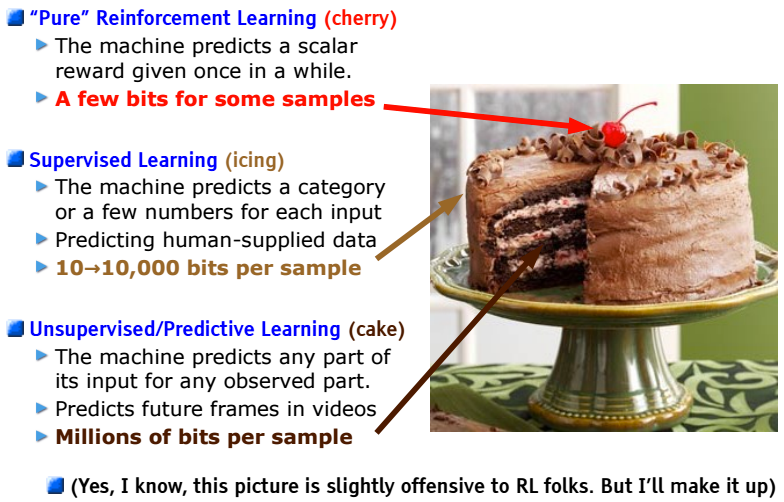
In the beginning of the conference, Yann LeCun gave a keynote, which may be considered a program speech for the whole conference. Besides starting the layered cake meme, he mentioned two ideas that he considers brightest in the last decade: adversarial training and external memory. My perception is that the most frequent buzzwords at the conference are:
  • generative adversarial networks (GAN),
  • recurrent neural networks (RNN),
  • reinforcement learning (RL),
  • robotics (done with or without RL).
Great engineers are good at defining useful abstractions. This LeCun’s layered cake metaphor was heavily re-used throughout the conference.
Andrew Ng gave a keynote on the workflow of applied DL research. Most ideas are trivial, although are often neglected. Here are a few of them. The most important metrics to track are: human error, training set error, and validation error. The gap between human and training set error is the bias. It can be solved by a bigger model or longer training. The validation/training gap is due to the variance. Once the bias problem is addressed, you can add more data or increase regularisation to reduce variance.

In practice, however, we have a different distribution of test data than of the training data. In that case, you might want to have two validation sets: one coming from training distribution, and another from test distribution. If you don’t have the latter, you will be solving a wrong problem. Domain adaptation methods may be also helpful, but are not quite practical at the moment.
He also heavily advocates for using the centralised data storage infrastructure that is easily available to all team members. It speeds up the progress a lot.
Currently, supervised learning dominates the landscape, while unsupervised and reinforcement learning are around for some time, but still cannot take off. Ng predicts that the second-biggest areas (after SL) will be not one of those, but transfer learning and multi-task learning. Those are important practical areas almost ignored by academic researchers.

There were seemingly few papers on architectural design (for supervised learning). Daniel Sedra gave a great talk on Neural networks of stochastic depth. The idea is to drop entire layers during training in ResNet-like architectures. That allows to grow them up to 1000+ layers, which gives significant improvement in accuracy on CIFAR (and not quite significant on ImageNet). Unfortunately, at test-time layers are there, so the inference time may be a problem. Another improvement is to add identity connection between each pair of layers, which also helps a bit.

Michael Figurnov, my academic sibling, presented a work on speeding up inference using so-called perforated convolutions. The idea is to skip some multiplications that do not impact the result of the operation a lot. In the follow-up work, he and co-authors suggest to skip the whole parts of the computation graph once they are estimated to be unimportant. This can potentially lead to significant speed-up, but for most practitioners it is the question of support in libraries such as CUDNN. Hopefully, we’ll be able to use it soon.
The method suggest not to waste computation time on background, but evaluate more ResNet layers where it can pay out more.
There was a demo I missed that demonstrated real-time object detection on a mobile device (if you have a link, please share with me!). It is based on YOLO, and the idea is to pre-compute and memoize some parts of the computational graph, then at inference time find the best approximation. There is some loss in accuracy, but real-time inference on the board looks impressive! 

The most interesting improvement for deep learning optimisation seems to be Weight normalisation. The paper builds on the idea of batch normalisation. It tries to explain the positive effect of it (i.e. staying on the unit sphere) and uses this intuition to propose an alternative way to stabilise the training process.

As I said above, GANs are a big (and controversial) topic here. It seems to be the most popular generative model for images, although variational autoencoders are still around. The training process is quite unstable, but the community is increasingly finding the ways to stabilise it. Most of them are hacks born in trial-and-error process. Soumith Chintala presented a list of 15 tricks in his talk How to train GAN? He promised to publish the slides later, but here is the writeup. If you will have to train GANs, make sure you read that first. There is no way you can guess this combination yourself (and papers typically do not mention all those hacks).

Poster by Soumith. TL;DR: use magic.
In the visual search field, there is a Universal correspondence network paper. Instead of matching features, it suggests to run one pass through the network to find dense correspondences. They claim that in comparison to extracting deep features for patches, the number of distance computations gets down from quadratic to linear (although, spatial index can also mitigate the issue). It appears to learn some notion of geometry/topology, i.e. one can train it to do rigid matching, as well as to look more at semantic similarity. The results they showed were on very similar images, so did not impress me much. Although it may had been done only to ease the visualisation.
Deep learning continues to disrupt traditional computer-vision pipelines.
For reinforcement learning, there is no single paper that I can pick as brightest, but the most impact seems to be done by publishing OpenAI Universe and DeepMind Lab, both are training environments for reinforcement learning algorithms stemming from computer-generated imagery (i.e. video games). It seems to be a valid step towards building intelligent agents operating in the real world, although there is a scepticism that it will be difficult to make the final step: the methods are data-hungry, and it is difficult to get a lot of data from anything rather than simulated environment, let alone having a frequent reward signal. This is one of the reasons researchers study the possibility of imitation learning, where a robot learns the cost function from demonstrations rather than taking it for granted. With this approach, we may be able to teach robots to perform tasks like pouring water into a glass by having a person or another robot showing it how to do it.
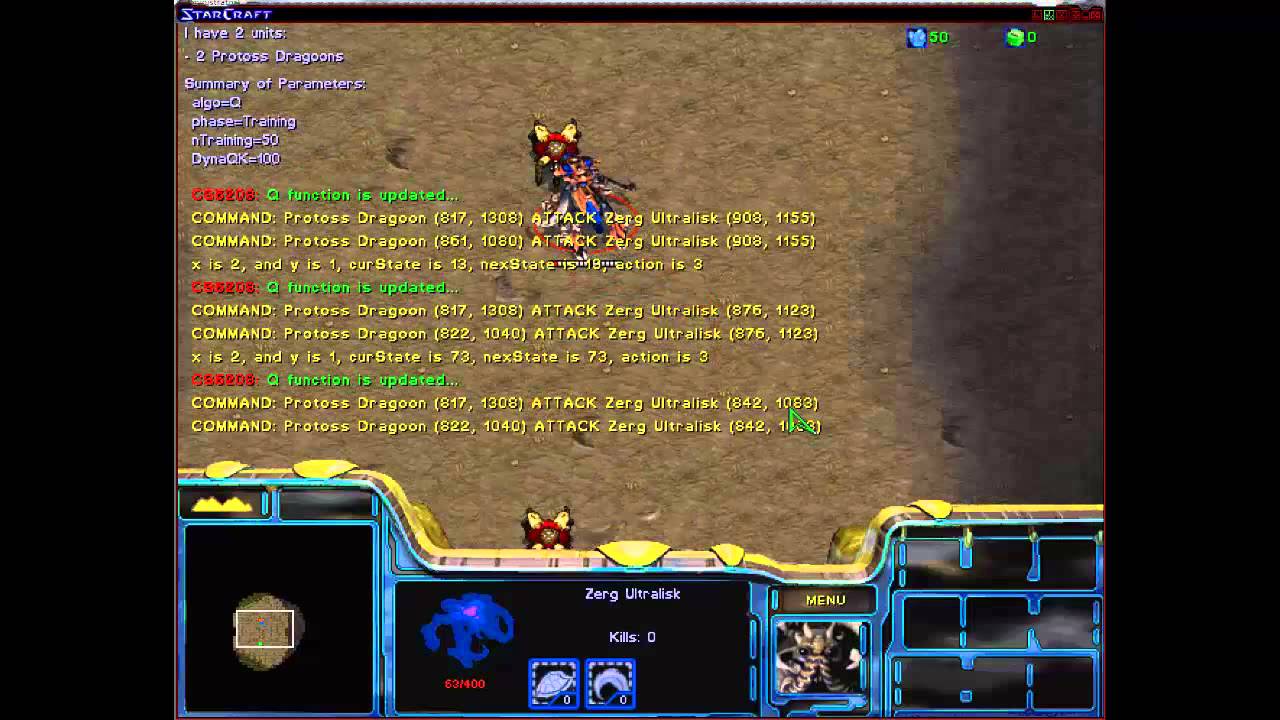
DeepMind collaborated with Blizzard to provide StarCraft API to facilitate training of RL agents. Now you have an excuse to play games at work.
Bayesian methods seem to be quite popular, and apparently can be successfully combined with neural networks (variational autoencoders and their variants are used a lot). Workshops on approximate variational inference and Bayesian deep learning have seen a large number of papers. Tutorial on variational inference (slides-pdf-1, slides-pds-2) reflected a significant progress in the recent years: things like reparametrisation trick and stochastic optimisation made possible to perform estimation of quite sophisticated posterior distributions. 
Slide by David Blei. Bayesian models have been long used successfully to estimate uncertainty, in particular to glue models to get complex pipelines while avoiding information loss. It is great we can use it with modern models as well.
Surely, an important part of the conference is socialisation. So thanks to everybody I had a chance to meet at the conference and had a productive (or just fun) conversation with. See you at the future conferences!

Read Users' Comments (9)

Asynchronous Fitter design pattern for training in IPython notebooks

[Cross-posted from CodeReview@SX]

The problem

When you work with Python interactively (e.g. in an IPython shell or notebook) and run a computationally intensive operation like fitting a machine-learning model that is implemented in a native code, you cannot interrupt the operation since the native code does not return execution control to the Python interpreter until the end of the operation. The problem is not specific to machine learning, although it is typical to run a training process for which you cannot predict the training time. In case it takes longer that you expected, to stop training you need to stop the kernel and thus lose the pre-processed features and other variables stored in the memory, i.e. you cannot interrupt only a particular operation to check a simpler model, which allegedly would be fit faster.

The solution

I propose an Asynchronous Fitter design pattern that runs fitting in a separate process and communicates the results back when they are available. It allows to stop training gracefully by killing the spawned process and then run training of a simpler model. It also allows to train several models simultaneously and work in the IPython notebook during model training. Note that multithreading is probably not an option, since we cannot stop a thread that runs an uncontrolled native code.

Here is a draft implementation:
from multiprocessing import Process, Queue
import time

class AsyncFitter(object):
    def __init__(self, model):
        self.queue = Queue()
        self.model = model
        self.proc = None
        self.start_time = None

    def fit(self, x_train, y_train):
        self.terminate()
        self.proc = Process(target=AsyncFitter.async_fit_, 
            args=(self.model, x_train, y_train, self.queue))
        self.start_time = time.time()
        self.proc.start()

    def try_get_result(self):
        if self.queue.empty():
            return None

        return self.queue.get()

    def is_alive(self):
        return self.proc is not None and self.proc.is_alive()

    def terminate(self):
        if self.proc is not None and self.proc.is_alive():
            self.proc.terminate()
        self.proc = None

    def time_elapsed(self):
        if not self.start_time:
            return 0

        return time.time() - self.start_time

    @staticmethod
    def async_fit_(model, x_train, y_train, queue):
        model.fit(x_train, y_train)
        queue.put(model)

Usage

It is easy to modify a code that uses scikit-learn to adopt the pattern. Here is an example:
import numpy as np
from sklearn.svm import SVC

model = SVC(C = 1e3, kernel='linear')
fitter = AsyncFitter(model)
x_train = np.random.rand(500, 30)
y_train = np.random.randint(0, 2, size=(500,))
fitter.fit(x_train, y_train)

You can check if training is still running by calling fitter.is_alive() and check the time currently elapsed by calling fitter.time_elapsed(). Whenever you want, you can terminate() the process or just train another model that will terminate the previous one. Finally, you can obtain the model by try_get_result(), which returns None when training is in progress.

The issues

As far as I understand, the training set is being pickled and copied, which may be a problem if it is large. Is there an easy way to avoid that? Note that training needs only read-only access to the training set.

What happens if someone loses a reference to an AsyncFitter instance that wraps a running process? Is there a way to implement an asynchronous delayed resource cleanup?

Read Users' Comments (3)

Machine learning in facebook

Last week Max Gubin gave a talk on how Facebook exploits machine learning. The talk was more technical then one might had expected, so I share some interesting facts in this posts. I hope it doesn’t disclose any secret information. :)

Max started with a screenshot of the Facebook interface, where each element was highlighted as beneficial of machine learning. Just to name some, they use learning to predict the order of stories in the newsfeed, groups/ads/chat contacts to show you, and even occasions when your account is supposedly hacked, so you need to verify your identity. For most of the tasks learning is probably trivial, but at least two of them involve complicated algorithms (see below).

Facebook engineers face number of difficulties. A user expects to load a page almost instantly, though network infrastructure already imposes some lag. To avoid further delaying, prediction should be done in tens of microseconds. Moreover, half a billion of daily-active users send a lot of queries, so massively-parallel implementations would be too expensive. They have no choice other than sticking to linear models. For example, they train a linear fitness function to rank the stories for the newsfeed (using e.g. hinge loss or logistic loss). It should be trained to satisfy multiple criteria, often contradicting. For example, maximizing personal user experience (showing most interesting stories) might hurt experience of other users (if one has few friends, they are the only users who can read his/her posts) or degrade the system as a whole (showing certain types of news might be not really interesting to anyone, while necessary to improve connectivity of the social network). Those criteria should be balanced in the learning objective, and the coefficients are changing over time. Even the personal user experience cannot be measured easily. The obvious thing to try is to ask users to label interesting stories (or use their Likes). However, such tests are always biased: Facebook tried to use this subjective labelling three times, and all of them were unsuccessful. Users just don’t tell what they really like.

Another challenge is the quickly-changing environment. For example, interest to specific ads may be seasoned. In advertising, one of the strategies is to maximize the click-through rate (CTR). The model for personalized ads should be able to learn online to adapt to changes efficiently. They use probit regression, where online updates can be written in a closed form, unlike to logistic regression (note the linear model again!). It is based on Microsoft’s TrueSkill™ method for learning ranks of players to find good matches and seems similar to what Bing uses for CTR maximization [Graepel et al., 2010].

Finally, Max mentioned the problem of estimating new features. The common practice in the industry is A/B testing, where a group of users is randomly selected to test some feature, and the rest of users are treated as the control group. Then they compare the indicators for those two groups (e.g. average time spent on the website, or clicks made on the newsfeed stories) and apply statistical tests. As usual, samples are typically small. For example, if they want to test a feature for search in Chinese, they take a small group of 10 million users, and hope that some of them will query in Chinese (recall that Facebook is unavailable in China). It is typically hard to prove a statistically significant improvement.

It was partially a hiring event. If you are looking for an internship or a full-time job, you may contact to their HR specialist in Eastern Europe Marina. Facebook also keeps in touch with universities, e.g. invites professors to give talks in their office or develop joint courses. Professors may apply, but I don’t know a contact for that.

Read Users' Comments (18)

All the summer schools

This summer I attended two conferences (3DIMPVT, EMMCVPR) and two summer schools. I know my latency is somewhat annoying, but it's better to review them now then never. :) This post is about the summer schools, and the following is going to be about the conferences.


PhD Summer School in Cambridge

Both schools were organized by Microsoft Research. The first one, PhD Summer School was in Cambridge, UK. The lectures covered some general issues for computer science PhD students (like using cloud computing for research and career perspectives) as well as some recent technical results by Microsoft Research. From the computer vision side, there were several talks:
  • Antonio Criminisi described their InnerEye system for retrieval of similar body part scans, which is useful for diagnosis based on similar cases' medical history. He also featured the basics of Random Forests as an advertisement to his ICCV 2011 tutorial. The new thing was using peculiar weak classifiers (like 2nd order separation surfaces). Antonio argued they perform much better then trees in some cases.
  • Andrew Fitzgibbon gave a brilliant lecture about pose estimation for Kinect (MSR Cambridge is really proud of that algorithm [Shotton, 2011], this is the topic for another post).
  • Olga Barinova talked about the modern methods of image analysis and her work for the past 2 years (graphical models for non-maxima suppression for object detection and urban scene parsing).
The other great talks were about .NET Gadgeteer, the system for modelling and even deployment of electronic gadgets (yes, hardware!), and F#, Microsoft's alternative to Scala, the language that combines object-oriented paradigm with functional. Sir Tony Hoare also gave a lecture, so I had a chance to ask him how he ended up in Moscow State University in the 60s. It turns out he studied statistics, and Andrey Kolmogorov was one of the leaders of the field that time, so that internship was a great opportunity for him. He said he had liked the time in Moscow. :) There were also magnificent lectures by Simon Peyton-Jones about giving talks and writing papers. Those advices are the must for everyone who does research, you can find the slides here. Slides for some of the lectures are available from the school page.

The school talks did not take all the time. Every night was occupied by some social event (go-karting, punting etc.) as well as unofficial after-parties in Cambridge pubs. Definitely it is the most fun school/conference I've attended so far. Karting was especially great, with the quality track, pit-stops, stats and prizes, so special thanks to Microsoft for including it to the program!


Microsoft Computer Vision School in Moscow

This year, Microsoft Research summer school in Russia was devoted to computer vision and organized in cooperation with our lab. The school started before its official opening with a homework assignment we authored (I was one of four student volunteers). The task was to develop an image classification method capable to distinguish two indoor and two outdoor classes. The results were rated according to the performance on the hidden test set. Artem Konev won the challenge with 95.5% accuracy and was awarded a prize consisted of an xBox and Kinect. Two years ago we used those data for the projects on Introduction to Computer Vision course, where nobody reached even 90%. It reflects not just the lore of participants, but also the progress of computer vision: all the top methods used PHOW descriptors and linear SVM with approximate decomposed χ2 kernel [Vedaldi and Zisserman, 2010], which were unavailable that time!

In fact, Andrew Zisserman was one of the speakers. Andrew is the most cited computer vision researcher and the only person whose Zisserman number is zero. :) His course was on Visual Search and Recognition, including instance-level and category-level recognition. The ideas that were relatively new:
  • when computing visual words, sometimes it is fruitful to use soft assignments to clusters, or more advanced methods like Locality-constrained linear coding [Wang et al., 2010];
  • for instance-level recognition it is possible to use query expansion to overcome occlusions [Chum et al., 2007]: the idea is to use the best matched images from the base as new queries;
  • object detection is traditionally done with sliding window, the problems here are: various aspect ratio, partial occlusions, multiple responses and background clutter for substantially non-convex objects;
  • for object detection use bootstrapped sequential classification: on the next stage take the false negative detections from the previous stage as negative examples and retrain the classifier;
  • multiple kernel learning [Gehler and Nowozin, 2009] is a hot tool that is used to find the ideal linear combination of SVM kernels: combining different features is fruitful, but learning the combination is not much better than just averaging (Lampert: “Never use MKL without comparison to simple baselines!”);
  • movies are common datasets, since there are a lot of repeated objects/people/environments, and the privacy issues are easy to overcome. The movies like Groundhog Day and Run Lola Run are especially good since they contain repeated episodes. You can try to find the clocks on Video Google Demo.
Zisserman talked about PASCAL challenge a lot. During a break he mentioned that he annotated some images himself since “it is fun”. One problem with the challenge is we don't know if the progress over years really reflects the increased quality of methods, or is just because of growth of the training set (though, it is easy to check).

Andrew Fitzgibbon gave two more great lectures, one about Kinect (with slightly different motivation than in Cambridge) and another about continuous optimization. He talked a lot about reconciling theory and practice:
  • the life-cycle of a research project is: 1) chase the high-hanging fruit (theoretically-sound model), 2) try to make stuff really work, 3) look for the things that confuse/annoy you and fix them;
  • for Kinect pose estimation, the good top-down method based on tracking did not work, so they ended up classifying body parts discriminatively, temporal smoothing is used on the late stage;
  • “don't be obsessed with theoretical guarantees: they are either weak or trivial”;
  • on the simplest optimization method: “How many people have invented [coordinate] alternation at some point of their life?”. Indeed, the method is guaranteed to converge, but the problems arise when the valleys are not axis-aligned;
  • gradient descent is not a panacea: in some cases it does small steps too, conjugate gradient method is better (it uses 1st order derivatives only);
  • when possible, use second derivatives to determine step size, but estimating them is hard in general;
  • one almost never needs to take the matrix inverse; in MATLAB, to solve the system Hd = −g, use backslash: d = −H\g;
  • the Friday evening method is to try MATLAB fminsearch (implementing the derivative-free Nelder-Mead method).
Dr. Fitzgibbon asked the audience what the first rule of machine learning is. I hardly helped over replying “Never talk about machine learning”, but he expected the different answer: “Always try the nearest neighbour first!”

Christoph Lampert gave lectures on kernel methods, and structured learning, and kernel methods for structured learning. Some notes on the kernel methods talk:
  • (obvious) don't rely on the error on a train set, and (less obvious) don't even report about it in your papers;
  • for SVM kernels, in order to be legitimate, a kernel should be an inner product; it is often hard to prove it directly, but there are workarounds: a kernel can be drawn from a conditionally positive-definite matrix; sum, product and exponent of a kernel(s) is a kernel too etc. (thus, important for multiple-kernel learning, linear combination of kernels is a kernel);
  • since training (and running) non-linear SVMs is computationally hard, explicit feature maps are popular now: try to decompose the kernel back to conventional dot product of modified features; typically the features should be transformed to infinite sums, so take first few terms [Vedaldi and Zisserman, 2010];
  • if the kernel can be expressed as a sum over vector components (e.g. χ2 kernel $\sum_d x_d x'_d / (x_d + x'_d)$), it is easy to decompose; radial basis function (RBF) kernel ($\exp (\|x-x'\|^2 / 2\sigma^2)$) is the exponent of a sum, so it is hardly decomposable (more strict conditions are in the paper);
  • when using RBF kernel, you have another parameter σ to tune; the rule of thumb is to take σ² equal to the median distance between training vectors (thus, cross-validation becomes one-dimensional).
Christoph also told a motivating story why one should always use cross-validation (so just forget the previous point :). Sebastian Nowozin was working on his [ICCV 2007] paper on action classification. He used the method by Dollár et al. [2005] as a baseline. The paper reported 80.6% accuracy on the KTH dataset. He outperformed the method by a couple of per cents and then decided to reproduce Dollár's results. Imagine his wonder when simple cross-validation (with same features and kernels) yielded 85.2%! So, Sebastian had to improve his method to beat the baseline.

I feel I should stop writing about the talks now since the post grows enormously long. Another Lampert's lecture and Carsten Rother's course on CRFs were close to my topic, so they deserve separate posts (I already reviewed basics of structured learning and max-product optimization in this blog). Andreas Müller blogged about the recent Ivan Laptev's action recognition talk on CVML, which was pretty similar to ours. The slides are available for all MSCVS talks, and videos will be shared in September.

There were also several practical sessions, but I personally consider them not that useful, because one hardly ever can feel the essence of a method in 1.5 hours changing the code according to some verbose instruction. It is more of an art to design such tutorials, and no one can really master it. :) Even if the task is well-designed, one may not succeed performing it due to technical reasons: during Carsten Rother's tutorial, Tanya and me spent half an hour to spot the bug caused by confusing input and index variable names (MATLAB is still dynamically typed). Ondrej Chum once mentioned how his tutorial was doomed since half of the students did not know how to work with sparse matrices. So, practical sessions are hard.

There was also a poster session, but I cannot remember a lot of bright works, unfortunately. Nataliya Shapovalova who won the best poster award, presented quite interesting work on action recognition, which I liked as well (and it is not the last name bias! :) My congratulations to Natasha!

The planned social events were not so exhaustive as in Cambridge, but self-organization worked out. The most prominent example was our overnight walk around Moscow, in which a substantial part of school participants took part. It included catching last subway train, drinking whiskey and gin, a game of guessing hallucinating names of each other, and moving a car from the tram rail to let the tram go in the morning. :) I also met some of OpenCV developers from Nizhny Novgorod there.


MSCVS is a one-time event, unfortunately. There are at least three annual computer vision summer schools in Europe: ICVSS (the most mature one, I attended it last year), CVML (held in France by INRIA) and VSSS (includes sport sessions besides the lectures, held in Zürich). If you are a PhD student in vision (especially in the beginning of your program), it is worth attending one of them each year to keep up with current trends in the vision community, especially if you don't go to the major conferences. The sets of topics (and even speakers!) have usually large intersection, so pick one of them. ICVSS has arguably the most competitive participant selection, but the application deadline and acceptance notification are in March, so one can apply to the other schools if rejected.

Read Users' Comments (7)

On structured learning

This post is devoted to structured learning, a novel machine learning paradigm which may be used for solving different computer vision problems. For example, finding optimal parameters of graphical models is essentially a structured learning problem. I am going to give an introductory talk on structured learning for Dmitry Vetrov's graphical models class this Friday at 4:20 pm, so please feel free to drop by if you are in Moscow (the talk is to be in Russian).

Structured learning is basically a very general supervised learning setting. Consider the classification setting as a basic problem. One needs to find parameters of a function that maps a feature vector to one of the pre-defined class labels $\mathbb{R}^m \to \{c_1, c_2, \dots, c_K\}$. The fundamental property is the classes are unordered and orthogonal. The latest means the probabilities of objects classified as different labels are uncorrelated (some negative correlation is normal since strong classifying of an object as $c_i$ decreases the probability for rest of the labels).

Now consider regression, which is another supervised learning problem where feature vectors map to real values: $\mathbb{R}^m \to \mathbb{R}$. It might be considered a classification problem with infinite number of classes. There are two obvious flaws in this reduction. First, a training set is unlikely to have at least one example for each class. To overcome this one can quantize the codomain and train a classifier over a finite set of class labels. However, it leaves us with the second flaw: the method does not take into account correlation between the possible outcomes. The bins are ordered: the training features that correspond to neighbouring bins should be handled differently from those that correspond to distant bins. That's why some global methods (like linear regression) are used.

The similar situation is in the case of a structured outcome. In this case, one usually has a plenty of possible outcomes, but they are not independent. The techniques of structured learning are applicable when the outcomes have some underlying structure, and the elements of the structure have similar sets of features. Also, it should be possible to estimate how bad the prediction is (often in terms of incorrectly predicted elements), which is called structured loss. The methods allow small deviations from the ideal training outcome, which are possible e.g. because of noise, but penalize the substantial ones (just like regression!). The prediction function (parameters of which are tuned) can thus be formalized as a mapping $\mathbb{R}^{m \times l} \to \{c_1, c_2, \dots, c_K\}^l$.

The possible example is hidden Markov model learning, where the elements are emission potentials and transition potentials, and the loss can be defined as the number of wrong HMM outputs. According to the upper formalization, there are $l$ elements, each represented by $m$ features (in practice, $m$ can vary for different types of elements). Since the labels of transition elements are strictly defined by emission outputs, not every outcome is possible.

Another example of a structured prediction problem is natural language parsing. Given a sentence of a natural language, the corresponding parsing tree is to be constructed. Surprisingly, parsing trees could also be represented as high-dimensional vectors, with constraints applied. To summarize, structure prediction has outcome that is multivariate, correlated and constrained.

Ideally, the parameters of structured prediction should be tuned via likelihood maximization, but this turns out to be intractable due to the need of computing the partition function on each gradient optimization step. That's why the L2-regularized hinge loss is usually minimized. The prediction algorithm is represented as a scoring function over possible outcomes. The task of the learning algorithm is to find the parameters of the scoring function to make it return maximum values for the true outcomes on the training set, and low ones for the instances that are far from optimal. Given that, the margin between good and bad possible outcomes should be maximized (in terms of scoring function value).

You can learn more about structure learning from Ben Taskar's NIPS 2007 tutorial. See also our recent 3DIMPVT paper for an up-to-date survey of MRF/CRF training methods and their applications.

PS. I've installed MathJax equation engine into the blog. Seems to work, huh?

Read Users' Comments (2)

IEEE goes evil?

In November, the IEEE released a new copyright agreement, that is to be signed by the authors of all papers published by the organization since January 2011. The main novelty is that the authors are not allowed to publish final versions of their papers on-line. Fortunately, we still may post the versions accepted for print (with post-review corrections), which is still great, indeed. You can find the FAQ concerning the new policy here.

It seems the IEEE realizes that nowadays there is almost no need in their printed materials and the digital library as search engines manage to find papers posted by their authors. No doubt that they do not want to restrict dissemination of scientific results, but that is a question of their survival as a major publishing organization. The worst is they use the drug-dealer strategy: first they organize great conferences and journals (the majority of top venues in my field are run by IEEE), and allow authors to re-publish anything on-line ("the first hit for free"), then cut it off. Yes, one still may post an accepted version, but who knows what is their next step?

The IEEE motivate their decision by preserving the value of their database: "the IEEE is better able to track usage of articles for the benefit of authors and journals". One can object that there are big and growing open-access databases like Mendeley, where all the statistics is open and refined (the personal info of users is known). Also, not all institutions have an access to the library. For example, my university (the largest one in Russia) does not. And I cannot afford to pay $25 per paper.

What can we do about that? Sure, it is impossible to stop publish in IEEE venues, although the community can find the way around, as was demonstrated by the founders of JMLR, now the major journal in machine learning, which was created to cancel the overhead of the commercial publishing model. Matt Blaze encourages the researchers not to serve as reviewers for IEEE. As for me, I'm too young (as a researcher) to be a reviewer. But it also has effect on me: I am now preparing a final version for the proceedings published by the IEEE, and I doubt if there is any use in improving my paper (even given a quality review), assuming that majority of researchers will use the accepted version and will never see the revised one.

UPD (Mart 14, 2011). I should have misunderstood the new policy at first, Blaze's post and IEEE terminology somehow misled me. The accepted paper means accepted for print by the IEEE, not the submitted for review. So, you still can use review results to correct the paper and post it on-line, then submit for publishing, where the formatting will probably be adjusted. So, any meaningful part could be reflected in the on-line version. I have corrected the post now, so it may seem weird.

Read Users' Comments (3)

Happy Thaknsgiving!

Here is a comic strip by Ryan Lake that illustrates the concept of Russell's turkey. The idea is simply the induction does not always work the way you expect. There could be some factors, which did not have influence on the training data, yet changing the learned concept dramatically. We should thus keep in mind that machine learning (which is based on induction) is not the panacea.


Bertrand Russell is well-known for his metaphors. Probably the most famous one is Russell's teapot that aims to show how pointless is to believe in god.

Happy Thanksgiving!

PS. I am reading Animal Farm by George Orwell now, it is a great animal metaphor too.

Read Users' Comments (2)

Max-product optimization methods and software

I hoped I would never post a sorry-for-not-posting message, but I do (and now I feel like I owe you a long post =). In fact, I have been being really busy, particularly with putting my masters thesis down to paper. However, it has a positive outcome: I systematized my knowledge about inference techniques in MRFs, and I'd like to share them here.

Please don't consider it a survey. While it claims to be quite comprehensive, it is not enough deep and verbose. You are not gonna see a lot of formulas, but the links to papers and implementations along with the recommendations on applicability of the methods and the software. It could be useful for anybody who wants to quickly try energy minimization in her task, but don't wanna spend a lot of time digging into the literature and implementing algorithms. So let's call this form of posting unsurvey. You can always find more details on the topic in Stan Li's book (not to be confused with Stan Lee recently appeared in The Big Bang Theory).

Max-product energy minimization problem arises in a number of fields such as statistical physics, social network analysis, and, of course, computer vision, where the problems like image denoising, dense stereo reconstruction, semantic segmentation lead to the single discrete optimization problem: maximize the product of some functions defined over nodes and edges of the graph G=(N,E), typically a grid over image pixels in low-level vision. Due to using logarithms, it is equivalent to maximizing the sum


where each Yi corresponds to a node of the graph and takes on a value from a fixed discrete range. It could be a class label in semantic segmentation, or a disparity value in the pixel in dense stereo. So-called potential functions φ (unary in the first term and pairwise in the second one) define possibility of the assignment given class labels to the nodes and edges correspondingly. They could be conditioned by the data. For example, unary potentials could reflect colour information in the pixel, and pairwise potentials could enforce assignment of the similar labels to the ends of an edge to provide smoothness in the resulting labelling. If the graph contains cliques of the order 3 and greater, one should consider more terms (as I explained earlier), but in practice higher order cliques are often ignored. Also, an important particular case, 4-connected grid, contains only second order cliques, that's why the research community focused on this "pairwise" problem.

In general, this maximization problem is NP-hard. That's why in the 1980s they solved it using genetic algorithms or simulated annealing. Fortunately, specific methods have been developed.

First of all, there are two cases when the exact global optimum could be found in polynomial time. The first is when the graph has a tree structure. Actually, I don't know application where this case is useful. Probably, it is good for analysis of parsing trees in natural language processing. In this case the maximum is found using the dynamic programming based belief propagation algorithm. One node is selected as the root, and messages are passed from the root and then back to the root. The optimal assignment is thus found.

Another polynomial case allows an arbitrary graph topology, but restricts the number of labels and the form of pairwise potentials. Only one of the two labels could be assigned to each node. Pairwise potentials should be submodular, i.e. φ(0,0) + φ(1,1) >= φ(0,1) + φ(1,0). Thus, the binary assignment implies that all the nodes should be divided into the two groups according to their labels. This division is found using the algorithm for finding minimum cut on the supplementary graph. Two fake nodes are added to the graph and declared as the source and the sink. Both fake nodes are adjacent to all the nodes of the "old" graph. Using your favourite min-cut/max-flow algorithm you can separate the nodes into two sets, which gives you the resulting labelling.

Unfortunately, the binary labelling problem is not so common too. In practice people want to choose one of the multiple labels for the nodes. This problem is NP-hard, but the iterative procedures of α-expansion and αβ-swap give good approximations with certain theoretical guarantees. [Boykov et al., 2001] During each iteration the min-cut algorithm is run, so there is an important constraint. Each projection to any two variables of pairwise potentials should be submodular. If it is hold for your energy, I recommend you to use this method since it is really fast and accurate. The implementation by Olga Veksler is available.

What should we do if the energy is not submodular and the graph contains cycles? There are some methods too, but they are not so fast and typically not so effective. First of all, the stated integer programming problem could be relaxed to linear programming. You can use any LP solver, but it will eventually take days to find the optimum. Moreover, it won't be exact, because the relaxed problem solution could be rounded back in multiple ways. No surprise here, because the possibility of getting the global optimum would prove that P = NP.

One of the methods for approaching the general problem is Loopy Belief Propagation [Kschischang, 2001]. No doubt, it is really loopy. Dynamic programming is used on the graph with loops, and it can eventually fall into the endless loop passing some messages along the loop. It is now considered outdated, but you can still try it, it is implemented in libDAI. The input is a factor graph, which is inconvenient in most cases, but really flexible (you could create cliques of arbitrary order).

State-of-the-art approach in general case, tree-reweighted message passing (TRW), has been developed by Wainwright and Kolmogorov. [Kolmogorov, 2006] It is based on the decomposition of the original graph to some graphs where exact message-passing inference is possible, i.e. trees. Message passing is done iteratively on the trees, and trees are enforced to assign the same values in particular nodes. The procedure is guaranteed to converge, but unfortunately not always to the global maximum. However, it is better than Loopy BP. Kolmogorov's implementation contains LBP and TRW-S under a common interface, so you can compare their performance. To understand the decomposition technique better, you could read Komodakis's paper [2007]. It describes a general decomposition framework.

Once a company of the world-leading MRF researchers gathered and implemented LBP, graph-cuts and TRW-S under common interface, investigated performance and even shared their code on a Middlebury college page. It would be great to use those implementations interchangeably, but unfortunately the interface is tailored for the stereo problem, i.e. it is impossible to use the general form of potentials. My latest research is about usage MRFs for laser scan classification, where the topology of the graph is far from a rectangular grid, and the potentials are more complex than the ones in the Potts model. So I ended up in writing my own wrappers.

Another interesting method was re-discovered by Kolmogorov and Rother [2007]. It is known as quadratic pseudo-boolean optimization (QPBO). This graph-cut based method can either assign a label to a node, or reject to classify it. The consistency property is guaranteed: if the label has been assigned, this exact label is assigned in the global optimum. The equivalent solution could be obtained using a specific LP relaxation with 1/2 probabilities for class labels allowed. I have not used the technique, so I cannot recommend an implementation.

To summarize, the algorithm for choosing an optimization method is the following. If your graph is actually a tree, use belief propagation. Otherwise, if your energy is submodular, use graph-cut based inference; it is both effective and efficient (even exact in the binary case). If not, use TRW-S, it often yields a good approximation.

Read Users' Comments (5)